

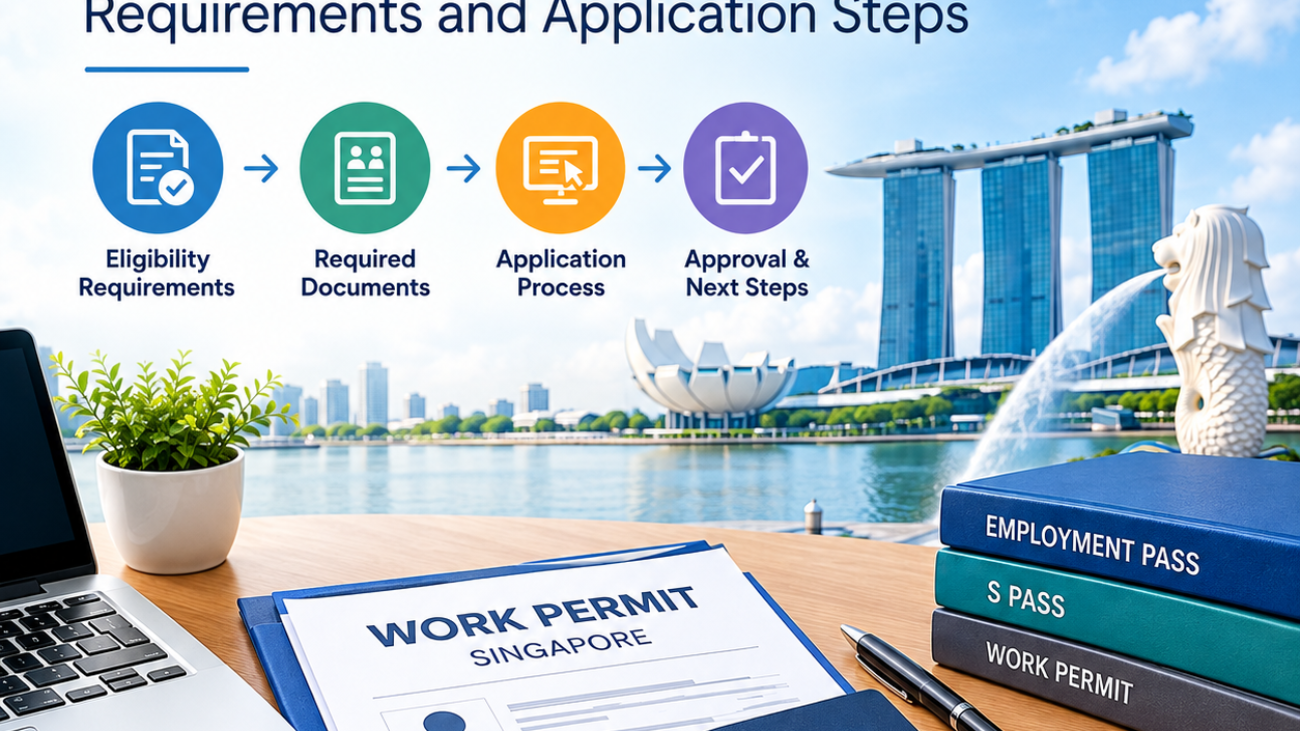
Singapore Work Permit Guide Infographic

Singapore Work Permit Guide for Employers

Hiring foreign workers in Singapore starts with one document: the Work Permit. This Singapore Work Permit Guide explains who qualifies, what the Ministry of Manpower (MOM) expects from employers, and how to apply step by step through WP Online.

The employer, not the worker, applies for the permit and carries the compliance load: a quota that caps foreign headcount, a monthly levy, a security bond for most workers, and mandatory medical insurance. Miss one step and the worker may be unable to enter Singapore or start work on time.

Use this guide as a checklist before you hire. Rules and rates change, so confirm current figures on the MOM website before you submit.

What Is a Singapore Work Permit?

A Work Permit (WP) lets employers in approved sectors hire semi-skilled foreign workers. The approved sectors are construction, marine shipyard, process, manufacturing and services. Each permit ties the worker to one employer and one sector, and the employer, or an appointed employment agent, makes the application.

A Work Permit is typically issued for up to two years, subject to the worker’s passport validity and the security bond. In the services sector, workers can stay employed until age 64.

Work Permit vs S Pass vs Employment Pass

PassTypical workerMonthly levyCounts toward quota
Work PermitSemi-skilledYesYes
S PassMid-skilled technical staffYesYes, shares the overall ceiling with Work Permit holders
Employment PassProfessionals, managers, executivesNoNo

Singapore Work Permit Requirements for Employers

Before you apply, check that your business and your candidate both meet MOM’s conditions.

Employer requirements

  • Your company is registered in Singapore. If you have never applied for a Work Permit or S Pass, you first declare your business activity so MOM can assign your sector.
  • You stay within your sector’s quota, known as the Dependency Ratio Ceiling (DRC).
  • You pay the monthly foreign worker levy for each worker.
  • You hold the worker’s written consent to apply for the Work Permit on their behalf.
  • You buy a S$5,000 security bond for each non-Malaysian worker. The bond must take effect when the worker arrives, and you cannot ask the worker to pay for it.
  • You buy medical insurance of at least S$60,000 per year for each worker, plus work injury compensation insurance where applicable.
  • You buy a Primary Care Plan for workers who stay in dormitories or work in construction, marine shipyard and process sectors.
  • You provide acceptable accommodation and fair wages.

Worker requirements

  • The worker comes from a source country approved for your sector and meets the age limits.
  • The worker passes a medical examination by a Singapore-registered doctor.
  • The worker meets any sector-specific skills rules.

Sector rules differ, so read MOM’s page for your sector, such as the services sector requirements.

Foreign Worker Quota and Levy

The quota caps the share of Work Permit and S Pass holders in your total workforce. If your services company exceeds 35%, for example, MOM will not approve more foreign workers.

SectorMaximum foreign share of workforce (DRC, 2026)
Construction83.3%
Process83.3%
Marine shipyard75%
Manufacturing60%
Services35%

The levy is a monthly charge per Work Permit holder, paid on top of salary. It starts on the day the Temporary Work Permit or Work Permit is issued and ends when the permit is cancelled or expires. Part months are charged at a daily rate.

Levy rates depend on your sector, the worker’s skill tier and how close you are to your ceiling. Higher tiers apply as your foreign share grows. Across sectors, the 2024 schedule ranged from about S250toS950 per worker per month, so check MOM’s current table for your sector before budgeting.

How to Apply for a Work Permit: Step by Step

MOM processes Work Permit applications online through WP Online, usually within one week.

  1. Check eligibility. Confirm your sector, your quota headroom and that your candidate qualifies.
  2. Get written consent. Obtain the worker’s written consent to apply for a Work Permit.
  3. Submit the application. Log in to WP Online, complete the form and pay the S$35 application fee.
  4. Receive in-principle approval (IPA). If approved, print the IPA letter from WP Online. Regenerate the IPA to get the worker’s FIN before you buy the security bond.
  5. Buy the security bond. For non-Malaysian workers, make sure your bank or insurer sends the bond details to MOM and that the bond takes effect when the worker arrives.
  6. Buy insurance. Take out medical insurance, work injury compensation insurance if applicable, and a Primary Care Plan if required. Declare the Primary Care Plan on WP Online.
  7. Arrange the medical exam. After arrival, send the worker to a Singapore-registered doctor.
  8. Request issuance. Log in to WP Online and request the Work Permit within the IPA validity period, paying S$35 per permit issued. If you cannot issue on time, extend the IPA through WP Online.
  9. Complete registration. Print the notification letter. If it says the worker must register fingerprints and photo at MOM Services Centre, they should do so within one week. The card is then delivered to you.

Work Permit Costs and Timelines

ItemWhat to expect
Application feeS$35 per application, paid on WP Online
Issuance feeS$35 per Work Permit issued
Processing timeWithin 1 week for most online applications; some cases take longer
Security bondS$5,000 per non-Malaysian worker, borne by the employer
Medical insuranceMinimum S$60,000 per year per worker
Foreign worker levyMonthly, per worker, by sector and tier
ValidityUp to 2 years, subject to passport and bond

Employer Obligations After the Permit Is Issued

The work does not end when the card arrives. Employers must:

  • Pay the levy each month and keep payment records, as MOM conducts audits.
  • Keep medical insurance valid for the full permit period.
  • Send female Work Permit holders for medical screening every 6 months.
  • Make sure the worker works only for you and only in the approved sector.
  • Keep within your quota when renewing or hiring more workers.
  • Renew the permit before it expires.
  • Cancel the Work Permit if the worker no longer works for you.

Common Reasons Work Permit Applications Fail

  • Quota exceeded. Many applications fail because the employer is already over the Dependency Ratio Ceiling. Check your headroom first.
  • Compliance history concerns. Past breaches can count against a new application.
  • Accommodation not met. Housing must meet MOM’s standards.
  • Incomplete insurance details. Medical insurance details must be submitted online before the permit can be issued.
  • Security bond not in effect on arrival. MOM cannot change the bond’s start date after the fact, and the worker may have to be sent home.
  • Late issuance. Request issuance within the IPA validity, or extend the IPA first.

How SRG Supports Employers Hiring in Singapore

A permit only helps if you hire the right person. SRG International Employment Agency is a Singapore-based agency that works to understand your role, skills and workforce requirements before it sources candidates. Our team assists throughout the recruitment process so hiring is more efficient, and our recruitment, staffing and manpower solutions can be tailored to your business.

Share your manpower needs with SRG, then follow the Work Permit steps above for each approved candidate.

Conclusion

This Singapore Work Permit Guide comes down to four things: check your quota, secure the bond and insurance, apply through WP Online, and stay compliant after issuance. Get the preparation right, and approval is usually quick.

Ready to hire? Contact SRG International Employment Agency to discuss your workforce requirements and find candidates who match your roles.


Building a Strong CV in Singapore

How to Build a Strong CV for Singapore Employers

Your CV is often the first and only chance to impress a hiring manager. In Singapore’s competitive job market, recruiters may review dozens of applications for a single role, and many spend only a short time on each one. A strong CV for Singapore employers needs to be clear, relevant and easy to scan.

This guide covers what Singapore employers look for, how to structure your CV, and the common mistakes that cost candidates interviews.

Why Your CV Matters in Singapore’s Job Market

Singapore is a fast-moving, skills-focused market. Employers want candidates who can show they’re capable, dependable and a good fit for the role. Many companies also use Applicant Tracking Systems (ATS) or recruitment agencies to screen CVs before they reach a hiring manager.

A strong CV for Singapore employers does three things:

  1. Shows relevance: it matches your skills and experience to the job.
  2. Proves impact: it highlights results, not just duties.
  3. Is easy to read: it lets a recruiter understand your profile in seconds.

CV vs Resume in Singapore: Is There a Difference?

In Singapore, the terms “CV” and “resume” are used almost interchangeably. Most employers expect a concise, well-organised document of one to two pages, with the most relevant experience first. Academic or research roles may accept longer CVs, but for most corporate, hospitality, retail, logistics and service roles, shorter is better.

What Singapore Employers Look For in a CV

  • Relevant experience: roles and achievements that match the job description.
  • Clear career progression: steady growth, or a sensible explanation for gaps and changes.
  • Skills and qualifications: both technical and soft skills.
  • Right to work: your nationality or work pass status, since employers need to understand your eligibility.
  • Professionalism: clean formatting, correct spelling and a logical layout.

Step-by-Step: How to Build a Strong CV for Singapore Employers

1. Start With Clear Contact Details

Place your details at the top:

  • Full name
  • Mobile number (with Singapore country code if applying from overseas)
  • Professional email address
  • LinkedIn profile URL (optional but recommended)
  • Location (e.g., “Singapore” or your city of residence)

Avoid unprofessional email addresses, and double-check every digit.

2. Write a Short, Targeted Professional Summary

Open with a 3–4 line summary that tells the employer who you are, what you do best and what you’re looking for. Tailor it to each role.

Example: “Customer service professional with 5+ years of experience in retail and hospitality, known for resolving client issues quickly and improving satisfaction scores. Seeking a customer-facing role in Singapore where I can contribute to team performance and long-term growth.”

3. List Work Experience in Reverse Chronological Order

Singapore employers generally prefer reverse chronological order, with your latest role first. For each role, include:

  • Job title
  • Company name
  • Location and employment dates (month and year)
  • 3–6 bullet points focused on achievements

Use the formula: action verb + task + measurable result.

  • ❌ “Responsible for handling customer complaints.”
  • ✅ “Resolved 40+ customer complaints weekly, improving satisfaction ratings by 15%.”

Numbers make your impact concrete. Where exact figures aren’t available, use realistic estimates you can back up in an interview.

4. Show Your Education and Certifications

List your highest qualification first, with the institution, course name and graduation year. Add relevant certifications, licences and training, such as SkillsFuture-supported courses, industry certifications or safety and compliance credentials. Entry-level candidates and fresh graduates can also include relevant projects, internships and CCAs.

5. Add a Skills Section With the Right Keywords

Read the job description closely and mirror its key terms where they honestly apply to you. This helps your CV pass ATS screening and signals fit to recruiters.

Split your skills into:

  • Technical or hard skills: software, tools, systems, languages
  • Soft skills: communication, teamwork, problem-solving, adaptability

Don’t pad this section. List only skills you can confidently discuss in an interview.

6. Include Work Pass Status and Availability

Singapore employers commonly want to know your eligibility to work. If relevant, state your citizenship, permanent residency, or the type of work pass you hold. Mentioning your notice period or availability can also help recruiters plan.

7. Keep Your CV to One or Two Pages

Aim for one page if you’re early in your career and two pages for experienced professionals. Cut outdated roles, irrelevant duties and filler phrases.

8. Choose a Clean, ATS-Friendly Format

  • Use a standard font such as Arial, Calibri or Times New Roman at 10–12 pt.
  • Use clear headings: Summary, Experience, Education, Skills.
  • Avoid heavy graphics, text boxes, tables and images that ATS software may misread.
  • Save as PDF unless the employer asks for a Word file.
  • Name the file professionally, e.g., FirstName_LastName_CV.pdf.

9. Proofread Before You Submit

Typos suggest carelessness. Read your CV aloud, run a spell-check and ask someone else to review it. Check that dates, job titles, and company names are consistent and accurate.

Tailor Your CV for Each Application

One generic CV rarely works. Before each application:

  • Re-read the job description and highlight the key requirements.
  • Move your most relevant achievements higher on the page.
  • Adjust your summary and keywords to match the role.

Tailoring takes ten to fifteen minutes and noticeably improves your chances of being shortlisted.

Common CV Mistakes to Avoid in Singapore

  • Submitting a CV longer than two pages without good reason
  • Using vague statements like “hardworking team player” without evidence
  • Listing duties instead of achievements
  • Leaving unexplained gaps or inconsistent dates
  • Using an unprofessional email address or outdated contact details
  • Sending the same CV to every employer
  • Including unnecessary personal information
  • Ignoring spelling and grammar errors

CV Checklist: Is Yours Ready?

  • Clear contact details and a professional email
  • Tailored professional summary
  • Achievement-focused work experience
  • Relevant education and certifications
  • Keywords from the job description
  • Work pass or eligibility status stated
  • One to two pages, ATS-friendly format
  • Proofread and saved as a PDF

Final Thoughts

Building a strong CV for Singapore employers comes down to clarity, relevance and proof. Keep it concise, tailor it to every role, show measurable achievements and make it easy for recruiters to see why you’re a good fit.

Ready for Your Next Opportunity in Singapore?

At SRG International Employment Agency Pte. Ltd., we connect candidates with suitable opportunities across multiple sectors in Singapore. Our team takes the time to understand your skills, experience and career goals before making the right match.

Looking for a new role? Visit srgemployment.sg to explore current opportunities and get in touch with our team.

Connecting People, Building Futures in Singapore

How to Choose the Best Employment Agency in Singapore

Searching for an employment agency that Singapore employers and candidates can trust? Your choice affects how quickly you hire or find work, and how well the match turns out. The right partner saves weeks of searching, filters out poor matches, and helps both sides start on solid ground—the wrong one wastes time, money, and goodwill.

Singapore has a large, active recruitment market, from small specialist firms to large international players. That choice is helpful, but it also makes it harder to tell which recruitment agency in Singapore you can genuinely rely on. This guide explains what an employment agency does, why people use one, and the eight factors, red flags and questions that will help you choose with confidence, whether you are an employer building a team or a candidate planning your next career move.

What does an employment agency in Singapore do?

An employment agency connects employers who need people with candidates who need work. In practice, a good agency will:

  • Understand the employer’s role, skills needed, team culture and budget
  • Source and screen candidates against those requirements
  • Understand each candidate’s skills, experience and career goals
  • Shortlist, arrange interviews and coordinate between both sides
  • Support the hiring process through to offer and placement
  • Provide flexible staffing and manpower solutions, such as contract or temporary roles

In Singapore, employment agencies are regulated. Under the Employment Agencies Act, every agency must hold a valid licence from the Ministry of Manpower (MOM), and each consultant must be registered as EA Personnel. Choosing a licensed employment agency in Singapore is your first layer of protection, and we return to it below.

Why use an employment agency instead of hiring or job hunting alone?

For employers

  • Speed: An agency already has a candidate pool and can shortlist faster than a new job advertisement.
  • Quality of screening: Consultants filter out unsuitable applicants before you spend time interviewing them.
  • Market insight: You get a realistic view of salary expectations, availability of talent, and competing offers.
  • Flexibility: Agencies can help with permanent hires, contract roles and short-term manpower needs.

For candidates

  • Access to opportunities: Agencies often know about vacancies before they’re advertised publicly.
  • Career guidance: A consultant can advise on CV presentation, interview preparation, and realistic salary expectations.
  • Better matching: Instead of applying blindly, you are introduced to roles that fit your skills and goals.
  • Time saved: Your profile is put in front of relevant employers without repeating the same application many times.

8 factors to look for when choosing an employment agency in Singapore

1. A valid MOM licence and registered consultants

This is non-negotiable. Every legitimate employment agency in Singapore must hold an Employment Agency (EA) licence issued by MOM, and the consultants you deal with must be registered EA Personnel. Licensed agencies display their EA licence number on their website and job advertisements. You can cross-check the agency name and licence number in MOM’s public directory of licensed employment agencies before you share any personal documents or sign any agreement.

2. Singapore market knowledge

An agency that understands the local employment market can advise on salary benchmarks, hiring trends, work pass requirements, and what employers or candidates realistically expect. Look for an agency that is based in Singapore, places people in Singapore, and can speak specifically about local conditions rather than giving generic answers.

3. A clear understanding process

The best agencies do not rush to send CVs or job links. They ask questions first. Employers should be asked about the role, required skills, team structure, working hours, and budget. Candidates should be asked about their experience, strengths, expected salary,y and career goals. If an agency skips this step, matching quality usually suffers.

4. Industry and role coverage that fits your needs

Some agencies specialise in one sector, such as IT, finance or healthcare. Others work as a general staffing agency in Singapore, covering multiple industries and job functions. Neither is automatically better. What matters is that the agency has current vacancies or a real talent pool in the field you care about. Ask which sectors and role levels they place most often.

5. Transparent fees and terms

A trustworthy agency explains fees clearly and in writing before you commit. Employers should know how placement fees are calculated, what the replacement or guarantee period is, and when payment is due. Candidates should ask whether any fee applies to them and read the terms carefully. Singapore regulations place limits on what agencies may charge job seekers, so if you are asked for a large upfront payment, treat it as a warning sign.

6. Communication and responsiveness

Notice how the agency treats you from the first conversation. Do they reply promptly, answer questions directly, and keep you updated? An agency that is hard to reach while trying to win your business is unlikely to improve once you have signed.

7. Track record and reputation

Check Google reviews, LinkedIn pages, testimonials, and any case studies the agency publishes. Ask for references or examples of similar roles they have filled. Remember that a few negative reviews are normal; look for patterns in how the agency responds to problems.

8. Ethical, two-sided matching

A good agency serves both parties honestly. It should not oversell a job to a candidate or exaggerate a candidate’s experience to an employer. Matches that work for both sides last longer, which is better for the employer, the candidate, and the agency’s own reputation.

Red flags to avoid when choosing an employment agency in Singapore

Walk away, or at least pause and verify, if an employment agency in Singapore:

  • Cannot give you an EA licence number, or the number does not match MOM’s records
  • Asks for large upfront fees from candidates before any job is secured
  • Guarantees a job or an unrealistically high salary
  • Pressures you to sign quickly without time to read the terms
  • Refuses to put fees, guarantee periods, or conditions in writing
  • Is vague about the employer, role or salary when presenting a vacancy
  • Asks for sensitive documents, such as passport or bank details, before it is necessary
  • Communicates only through personal messaging accounts with no company website or office details

Questions to ask a recruitment agency in Singapore before you commit

A short conversation with the agency can tell you most of what you need to know. Ask:

  1. What is your EA licence number, and which consultant will handle my case?
  2. Which industries and roles do you place most often in Singapore?
  3. How do you screen candidates, or how do you assess employer requirements?
  4. What are your fees, and when are they payable?
  5. What happens if a placed candidate leaves early or the match does not work out?
  6. How long does a typical placement take for a role like mine?
  7. How will you keep me updated during the process?
  8. Can you share examples or references of similar placements?

Tips for employers choosing a recruitment partner

  • Share a detailed brief. Give the agency the job scope, must-have skills, salary range, and team context. The clearer your brief, the better the shortlist.
  • Agree on the process. Confirm how many candidates you will see, how fast they will be presented,d and how feedback will be handled.
  • Check the fit with your needs. Decide whether you need a permanent hire, contract work, er or flexible manpower, and choose an agency that offers that.
  • Give timely feedback. Quick responses after interviews keep strong candidates engaged.

Tips for candidates choosing an employment agency

  • Verify before you share documents. Confirm the licence first, then send your CV and personal details.
  • Be honest about your goals. Clear information on salary, location, and career direction helps your consultant find realistic matches.
  • Ask about the employer and role. You should be told who the employer is, the job scope and the salary range before you are put forward.
  • Keep your profile current. Update your consultant when your availability or expectations change.

How SRG International Employment Agency supports employers and candidates

SRG International Employment Agency Pte. Ltd. is a Singapore-based employment agency that connects businesses with suitable talent and helps candidates find meaningful employment opportunities. Our approach is built on the factors in this guide.

For candidates:

  • Singapore-based recruitment: We understand the Singapore employment market and connect candidates with opportunities based in Singapore.
  • A professional process: We work to understand candidate profiles and employer requirements before making suitable matches.
  • Opportunities across sectors: Candidates can explore roles across different industries and job functions, depending on current vacancies.

For employers:

  • Understanding your requirements: We take the time to understand the role, skills, and workforce needs.
  • Candidate sourcing: We help identify potential candidates based on your requirements.
  • Efficient recruitment support: Our team assists throughout the process to make hiring more efficient.
  • Flexible workforce solutions: Recruitment, staffing, and manpower solutions can be tailored to different business requirements.

Learn more about our services at srgemployment.sg.

Conclusion: Choose an employment agency that earns your trust

The best employment agency Singapore has to offer is the one that is properly licensed, understands your needs, communicates openly, and aims for matches that work for both employer and candidate. Verify the licence, ask the right questions, compare terms, and trust your experience of how the agency treats you from the first conversation.

If you are an employer looking to strengthen your team, or a candidate ready for your next opportunity in Singapore, SRG International Employment Agency is here to make recruitment more straightforward, efficient and professional. Visit srgemployment.sg to get in touch