

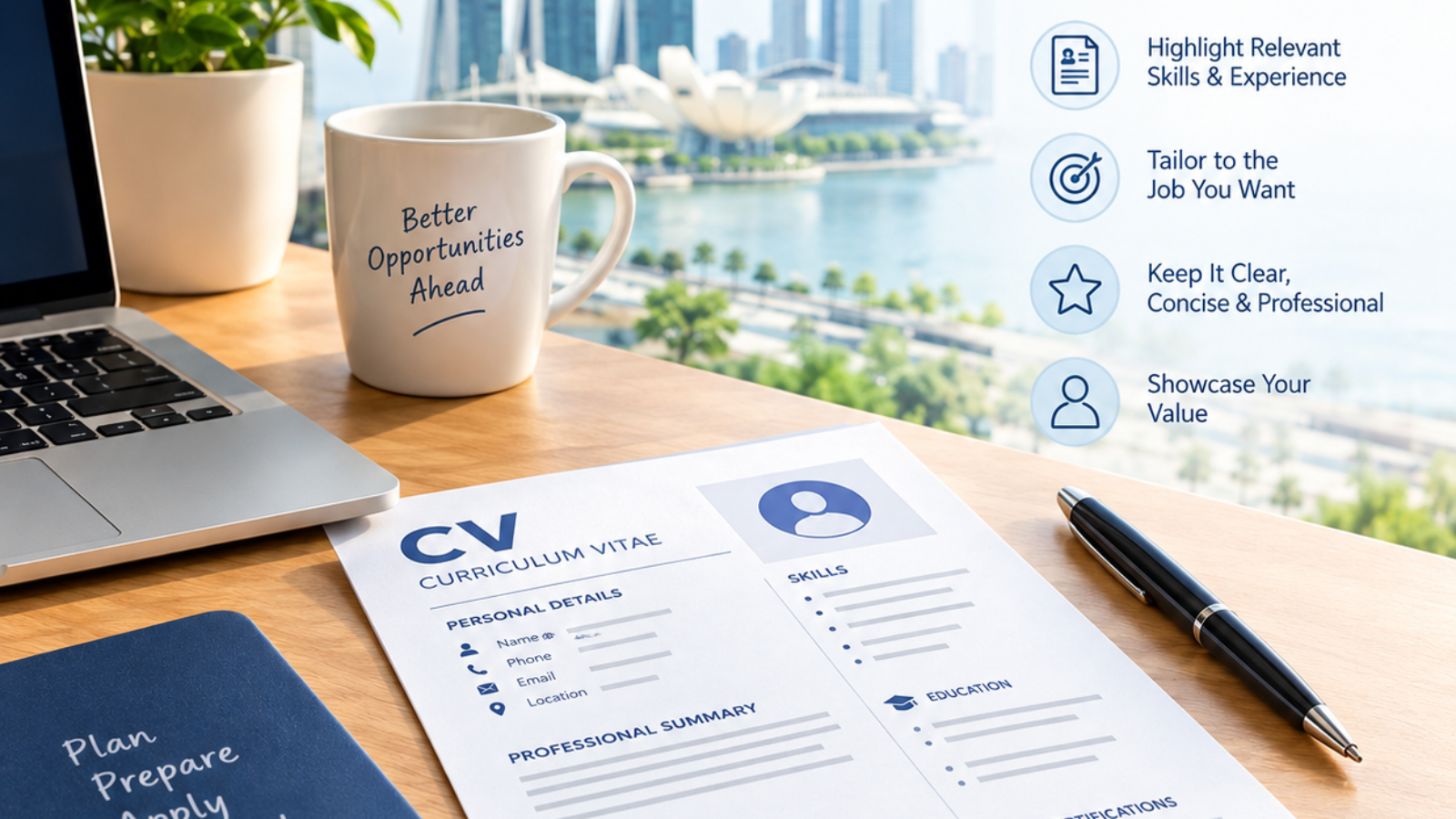
Your CV is often the first and only chance to impress a hiring manager. In Singapore’s competitive job market, recruiters may review dozens of applications for a single role, and many spend only a short time on each one. A strong CV for Singapore employers needs to be clear, relevant and easy to scan.
This guide covers what Singapore employers look for, how to structure your CV, and the common mistakes that cost candidates interviews.
Why Your CV Matters in Singapore’s Job Market
Singapore is a fast-moving, skills-focused market. Employers want candidates who can show they’re capable, dependable and a good fit for the role. Many companies also use Applicant Tracking Systems (ATS) or recruitment agencies to screen CVs before they reach a hiring manager.
A strong CV for Singapore employers does three things:
- Shows relevance: it matches your skills and experience to the job.
- Proves impact: it highlights results, not just duties.
- Is easy to read: it lets a recruiter understand your profile in seconds.
CV vs Resume in Singapore: Is There a Difference?
In Singapore, the terms “CV” and “resume” are used almost interchangeably. Most employers expect a concise, well-organised document of one to two pages, with the most relevant experience first. Academic or research roles may accept longer CVs, but for most corporate, hospitality, retail, logistics and service roles, shorter is better.
What Singapore Employers Look For in a CV
- Relevant experience: roles and achievements that match the job description.
- Clear career progression: steady growth, or a sensible explanation for gaps and changes.
- Skills and qualifications: both technical and soft skills.
- Right to work: your nationality or work pass status, since employers need to understand your eligibility.
- Professionalism: clean formatting, correct spelling and a logical layout.
Step-by-Step: How to Build a Strong CV for Singapore Employers
1. Start With Clear Contact Details
Place your details at the top:
- Full name
- Mobile number (with Singapore country code if applying from overseas)
- Professional email address
- LinkedIn profile URL (optional but recommended)
- Location (e.g., “Singapore” or your city of residence)
Avoid unprofessional email addresses, and double-check every digit.
2. Write a Short, Targeted Professional Summary
Open with a 3–4 line summary that tells the employer who you are, what you do best and what you’re looking for. Tailor it to each role.
Example: “Customer service professional with 5+ years of experience in retail and hospitality, known for resolving client issues quickly and improving satisfaction scores. Seeking a customer-facing role in Singapore where I can contribute to team performance and long-term growth.”
3. List Work Experience in Reverse Chronological Order
Singapore employers generally prefer reverse chronological order, with your latest role first. For each role, include:
- Job title
- Company name
- Location and employment dates (month and year)
- 3–6 bullet points focused on achievements
Use the formula: action verb + task + measurable result.
- ❌ “Responsible for handling customer complaints.”
- ✅ “Resolved 40+ customer complaints weekly, improving satisfaction ratings by 15%.”
Numbers make your impact concrete. Where exact figures aren’t available, use realistic estimates you can back up in an interview.
4. Show Your Education and Certifications
List your highest qualification first, with the institution, course name and graduation year. Add relevant certifications, licences and training, such as SkillsFuture-supported courses, industry certifications or safety and compliance credentials. Entry-level candidates and fresh graduates can also include relevant projects, internships and CCAs.
5. Add a Skills Section With the Right Keywords
Read the job description closely and mirror its key terms where they honestly apply to you. This helps your CV pass ATS screening and signals fit to recruiters.
Split your skills into:
- Technical or hard skills: software, tools, systems, languages
- Soft skills: communication, teamwork, problem-solving, adaptability
Don’t pad this section. List only skills you can confidently discuss in an interview.
6. Include Work Pass Status and Availability
Singapore employers commonly want to know your eligibility to work. If relevant, state your citizenship, permanent residency, or the type of work pass you hold. Mentioning your notice period or availability can also help recruiters plan.
7. Keep Your CV to One or Two Pages
Aim for one page if you’re early in your career and two pages for experienced professionals. Cut outdated roles, irrelevant duties and filler phrases.
8. Choose a Clean, ATS-Friendly Format
- Use a standard font such as Arial, Calibri or Times New Roman at 10–12 pt.
- Use clear headings: Summary, Experience, Education, Skills.
- Avoid heavy graphics, text boxes, tables and images that ATS software may misread.
- Save as PDF unless the employer asks for a Word file.
- Name the file professionally, e.g., FirstName_LastName_CV.pdf.
9. Proofread Before You Submit
Typos suggest carelessness. Read your CV aloud, run a spell-check and ask someone else to review it. Check that dates, job titles, and company names are consistent and accurate.
Tailor Your CV for Each Application
One generic CV rarely works. Before each application:
- Re-read the job description and highlight the key requirements.
- Move your most relevant achievements higher on the page.
- Adjust your summary and keywords to match the role.
Tailoring takes ten to fifteen minutes and noticeably improves your chances of being shortlisted.
Common CV Mistakes to Avoid in Singapore
- Submitting a CV longer than two pages without good reason
- Using vague statements like “hardworking team player” without evidence
- Listing duties instead of achievements
- Leaving unexplained gaps or inconsistent dates
- Using an unprofessional email address or outdated contact details
- Sending the same CV to every employer
- Including unnecessary personal information
- Ignoring spelling and grammar errors
CV Checklist: Is Yours Ready?
- Clear contact details and a professional email
- Tailored professional summary
- Achievement-focused work experience
- Relevant education and certifications
- Keywords from the job description
- Work pass or eligibility status stated
- One to two pages, ATS-friendly format
- Proofread and saved as a PDF
Final Thoughts
Building a strong CV for Singapore employers comes down to clarity, relevance and proof. Keep it concise, tailor it to every role, show measurable achievements and make it easy for recruiters to see why you’re a good fit.
Ready for Your Next Opportunity in Singapore?
At SRG International Employment Agency Pte. Ltd., we connect candidates with suitable opportunities across multiple sectors in Singapore. Our team takes the time to understand your skills, experience and career goals before making the right match.
Looking for a new role? Visit srgemployment.sg to explore current opportunities and get in touch with our team.
Add a Comment